
Ibrahim Rauza
A Jewel-box Tomb and Mosque on One Plinth
Overview
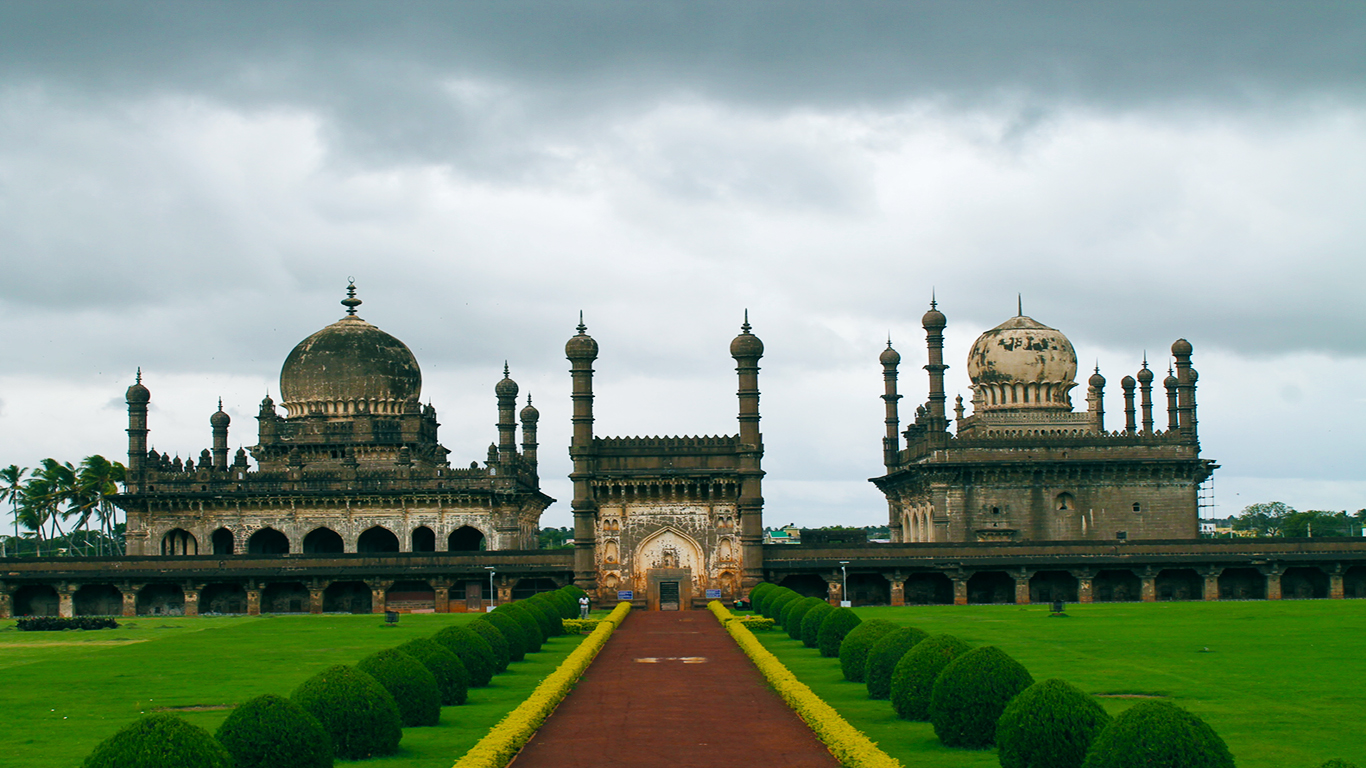
Ibrahim Rauza is the tomb-and-mosque complex of Ibrahim Adil Shah II, sultan of Bijapur, and his family, built in the early seventeenth century and traditionally credited to the architect Malik Sandal. A tomb and a mosque of near-identical proportion face each other across a raised terrace with a central water tank, their walls covered in delicate carved stone and calligraphy. Admired for its fine balance and detail, it is often said to have influenced later Mughal builders. It stands in Vijayapura (Bijapur), Karnataka, under the Archaeological Survey of India. MyTripMyTravel arranges a calm, escorted visit with time to read the stonework closely.
If Gol Gumbaz overwhelms by scale, Ibrahim Rauza persuades by refinement. Here two elegant buildings, a tomb and a mosque, sit facing each other on a single walled terrace, mirrored in proportion and connected by a formal garden with a central tank. The complex was built in the early seventeenth century for Ibrahim Adil Shah II, one of the most cultured rulers of the Bijapur sultanate, and for members of his family.
The pleasure of the place is in its surfaces. The tomb's outer walls carry finely cut stone screens, bands of Persian and Arabic calligraphy and shallow relief, all worked with a jeweller's patience. The tradition that its harmony helped shape the thinking behind later Mughal mausoleums, including the Taj Mahal, speaks to how highly its design has long been regarded, even if the exact line of influence is debated.
MyTripMyTravel keeps this stop unhurried, because the reward of Ibrahim Rauza lies in slowing down to trace the carving and the calligraphy rather than ticking off another dome.
At a glance
Ibrahim Rauza in brief
What to see
Highlights
The tomb
The mausoleum holding the graves of Ibrahim Adil Shah II and members of his family, its walls covered in intricate stone carving and inscribed panels.
The mosque
A mosque of matching proportion facing the tomb across the terrace, so the two buildings answer each other in a single composition.
Calligraphic panels
Bands of Arabic and Persian inscription cut into the stone, among the finest decorative lettering of the Deccan sultanates.
The raised terrace and tank
The shared plinth with its central water tank and garden setting, which unifies the two structures and gives the complex its calm symmetry.
Perforated screens
Delicately pierced stone jalis that filter the Deccan light into the tomb chamber.
Visitor information
Our tips
Come in low, raking light, when the shallow carving and calligraphy stand out in relief.
Walk the full terrace to see how the tomb and mosque are set as a deliberate mirrored pair.
Remove shoes where required near the mosque and dress modestly, as at any active place of prayer.
Pair it with Gol Gumbaz on the same Vijayapura circuit for a fuller picture of Adil Shahi architecture.
Good to know
Ibrahim Rauza, your questions
What is Ibrahim Rauza?
It is a walled complex containing the tomb of Ibrahim Adil Shah II of Bijapur and his family, together with a matching mosque, built in the early seventeenth century and known for its exceptionally fine stone carving.
Did it really inspire the Taj Mahal?
It is often said to have influenced later Mughal mausoleum design, and it is much admired for its proportion and detail. The precise degree of influence is a matter of tradition and scholarly discussion rather than settled record.
Who is buried here?
Ibrahim Adil Shah II along with members of his family. The tomb chamber holds their cenotaphs.
Is there an entry fee?
Yes, a nominal ASI ticket, with a possible camera fee. We arrange tickets as part of the visit.
How much time do I need?
Around forty-five minutes to an hour is enough to appreciate both buildings and the carving, more if you enjoy studying the calligraphy.
More in Bijapur (Vijayapura)
Visit with us
See Ibrahim Rauza, properly.
A private, chauffeured visit with a licensed expert guide, timed for the best light and the smallest crowds. We fold Ibrahim Rauza into a wider Bijapur (Vijayapura) and South India itinerary, built entirely around you.
- Skip the queue where possible, at the right hour
- Licensed local guide who brings the story to life
- Private car and chauffeur, door to door
Plan your trip
Plan a visit to Ibrahim Rauza
Free, no obligation quote. Your details stay private.