
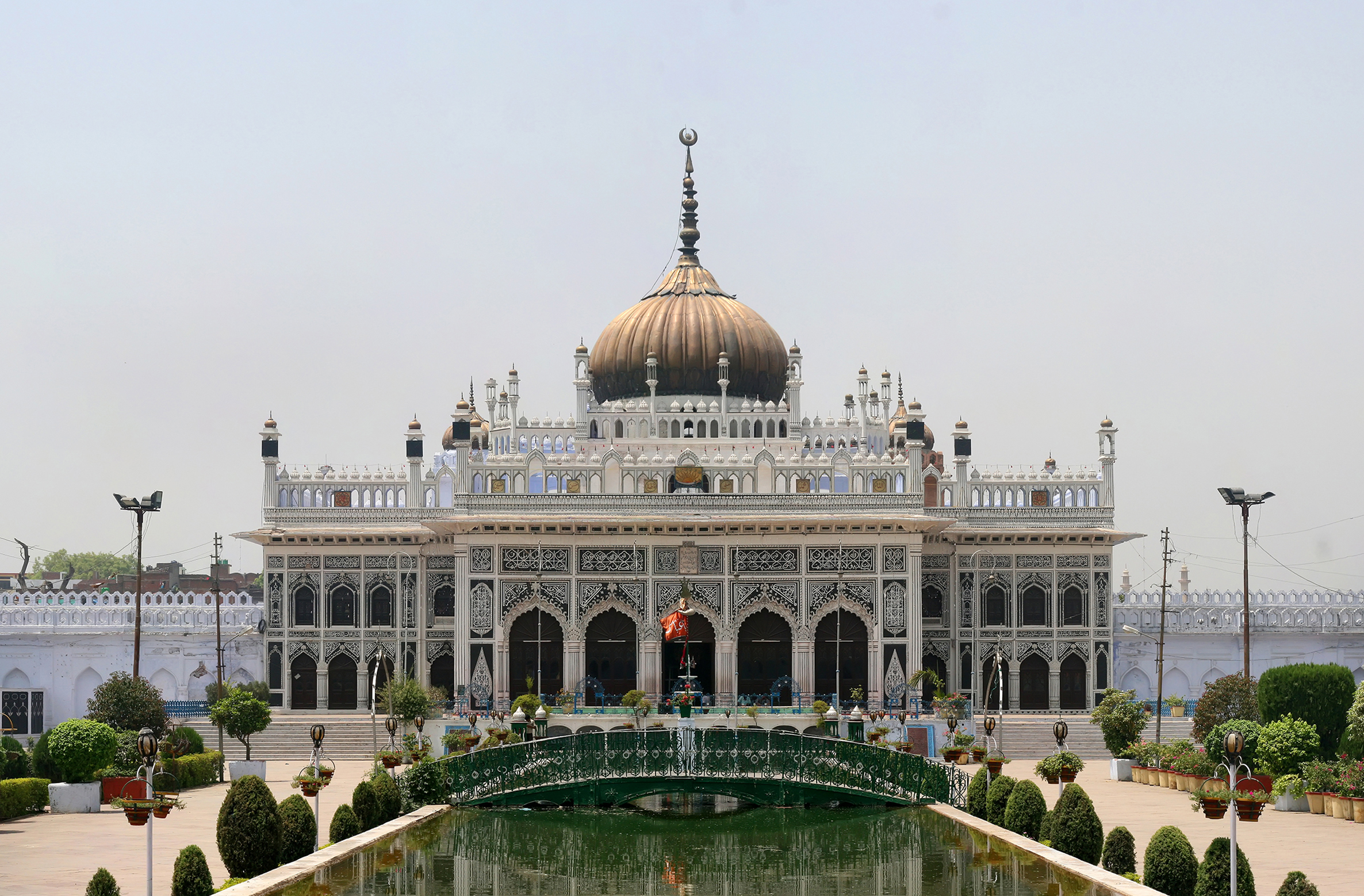
Chota Imambara (Hussainabad Imambara)
Lucknow's Palace of Lights
Overview
The Chota Imambara, also called the Hussainabad Imambara, was built in 1838 by Nawab Muhammad Ali Shah of Awadh as a congregation hall and his own mausoleum. Famous for the chandeliers and lamps that earned it the nickname 'Palace of Lights', it carries a gilded dome and Arabic calligraphy across its facade. It remains a place of Shia mourning during Muharram. A nominal ticket admits visitors. MyTripMyTravel includes it on an Awadhi heritage circuit with an informed guide to unpack its decoration and purpose.
Smaller and more intimate than the Bara Imambara, the Chota Imambara compensates with sheer glitter. Rows of chandeliers, glass lamps and mirror-work fill the hall, and when lit for festivals it fully earns its popular name, the Palace of Lights.
It was built in 1838 by Nawab Muhammad Ali Shah, the third Nawab of Awadh, to serve as an imambara, a hall for Shia commemoration, and as his own resting place. The exterior carries a gilded dome and bands of Arabic calligraphy, while the grounds hold subsidiary tombs and a water channel.
This remains a living religious site, central to Muharram observances. MyTripMyTravel visits with a guide who explains the imambara tradition and the ornament within, and reminds guests that a nominal ticket and respectful dress are expected.
At a glance
Chota Imambara (Hussainabad Imambara) in brief
What to see
Highlights
Chandeliers and lamps
Belgian-glass chandeliers and lamps fill the hall, giving the imambara its 'Palace of Lights' name.
Gilded dome
A golden dome crowns the main hall and dominates the courtyard skyline.
Calligraphy facade
Bands of Arabic Quranic calligraphy decorate the exterior of the building.
Tombs within
The Nawab Muhammad Ali Shah and family members are buried inside the complex.
Courtyard and water channel
A formal forecourt with a central water channel leads up to the imambara.
Visitor information
Our tips
Dress modestly, as it is an active religious site.
Remove shoes before entering the main hall.
Combine it with the Bara Imambara and Rumi Darwaza.
Expect changed access during Muharram observances.
Good to know
Chota Imambara (Hussainabad Imambara), your questions
Why is it called the Palace of Lights?
Its hall is filled with chandeliers, glass lamps and mirror-work that dazzle when illuminated for festivals.
Who built it?
It was built in 1838 by Nawab Muhammad Ali Shah of Awadh.
What is an imambara?
It is a hall used by Shia Muslims for commemorations, especially during Muharram.
Is there a ticket?
Yes, a nominal entry ticket applies, and a camera fee may be charged.
What else can I see nearby?
The Bara Imambara and the Rumi Darwaza are close and usually visited on the same circuit.
More in Lucknow
Visit with us
See Chota Imambara (Hussainabad Imambara), properly.
A private, chauffeured visit with a licensed expert guide, timed for the best light and the smallest crowds. We fold Chota Imambara (Hussainabad Imambara) into a wider Lucknow and North India itinerary, built entirely around you.
- Skip the queue where possible, at the right hour
- Licensed local guide who brings the story to life
- Private car and chauffeur, door to door
Plan your trip
Plan a visit to Chota Imambara (Hussainabad Imambara)
Free, no obligation quote. Your details stay private.