
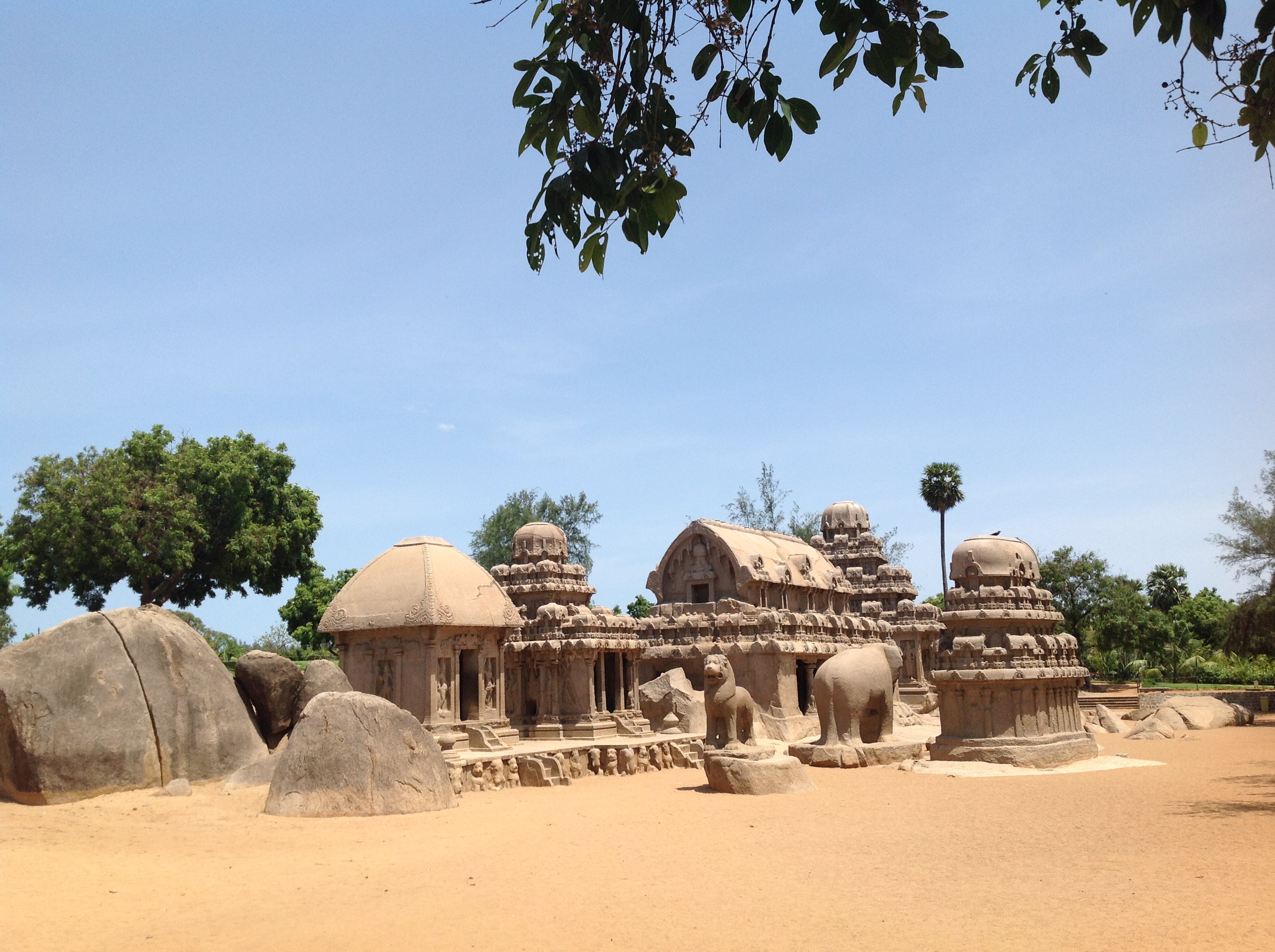
Pancha Rathas
Five Temples Carved From Single Stones
Overview
The Pancha Rathas are a cluster of five monolithic temples at Mahabalipuram (Mamallapuram), Tamil Nadu, India, each carved from a single outcrop of granite in the 7th century under the Pallava king Narasimhavarman I (Mamalla). Named after the five Pandava brothers and their queen Draupadi, the Dharmaraja, Bhima, Arjuna, Nakula-Sahadeva and Draupadi rathas, each takes the form of a temple chariot, and each experiments with a different architectural style. Left unfinished and never consecrated, they are effectively a Pallava sculptors' catalogue in stone. They form part of a UNESCO World Heritage Site. MyTripMyTravel arranges an escorted, expert-guided reading.
The Pancha Rathas are one of the strangest and most instructive sights in India: five complete-looking temples, each hewn top-down from a single mass of granite, standing in a row like a display of prototypes.
They carry the names of the Pandava brothers and Draupadi, but the names are later folklore, what matters is that each ratha tests a different temple form, from the hut-roofed Draupadi shrine to the three-storey Dharmaraja. Carved under Narasimhavarman I in the 7th century, they were left unfinished and never consecrated, which is exactly why the chisel marks and the top-down method remain so legible.
MyTripMyTravel walks the group with an expert guide who reads them as a design experiment, the moment South Indian temple architecture was being invented in stone, alongside the monolithic elephant, lion and bull beside them.
At a glance
Pancha Rathas in brief
What to see
Highlights
Dharmaraja Ratha
The largest of the five, a three-storey pyramidal shrine and the most elaborate design.
Draupadi Ratha
The smallest, shaped like a thatched hut and dedicated to the goddess Durga.
Bhima Ratha
The long, barrel-vaulted ratha modelled on a wooden hall roof.
The monolithic animals
A life-size elephant, a lion and a Nandi bull carved from the rock beside the rathas.
Unfinished tool marks
Visible chisel work showing how each ratha was carved from the top down.
Visitor information
Our tips
Go early, the open compound offers no shade once the sun is high.
Look closely at the unfinished tool marks; they reveal the top-down carving method better than any label.
Use the same ASI ticket for the Shore Temple the same day.
A guide is what separates 'five nice rocks' from a lesson in how a temple style was invented.
Good to know
Pancha Rathas, your questions
Are the Pancha Rathas really carved from single stones?
Yes, each of the five is hewn from a single outcrop of granite, carved from the top down, which is why they are called monolithic rathas.
Were they ever used as temples?
No, they were left unfinished after the period of Narasimhavarman I and never consecrated, so they served as architectural experiments rather than working shrines.
Why are they named after the Pandavas?
The names come from later folklore linking them to the Mahabharata's five Pandava brothers and Draupadi; they are not their original dedications.
How long do they take to see?
About 45 to 60 minutes with a guide for the five rathas and the monolithic animals.
Is it a UNESCO site?
Yes, the rathas are inscribed within the Group of Monuments at Mahabalipuram.
More in Mahabalipuram
Visit with us
See Pancha Rathas, properly.
A private, chauffeured visit with a licensed expert guide, timed for the best light and the smallest crowds. We fold Pancha Rathas into a wider Mahabalipuram and South India itinerary, built entirely around you.
- Skip the queue where possible, at the right hour
- Licensed local guide who brings the story to life
- Private car and chauffeur, door to door
Plan your trip
Plan a visit to Pancha Rathas
Free, no obligation quote. Your details stay private.