
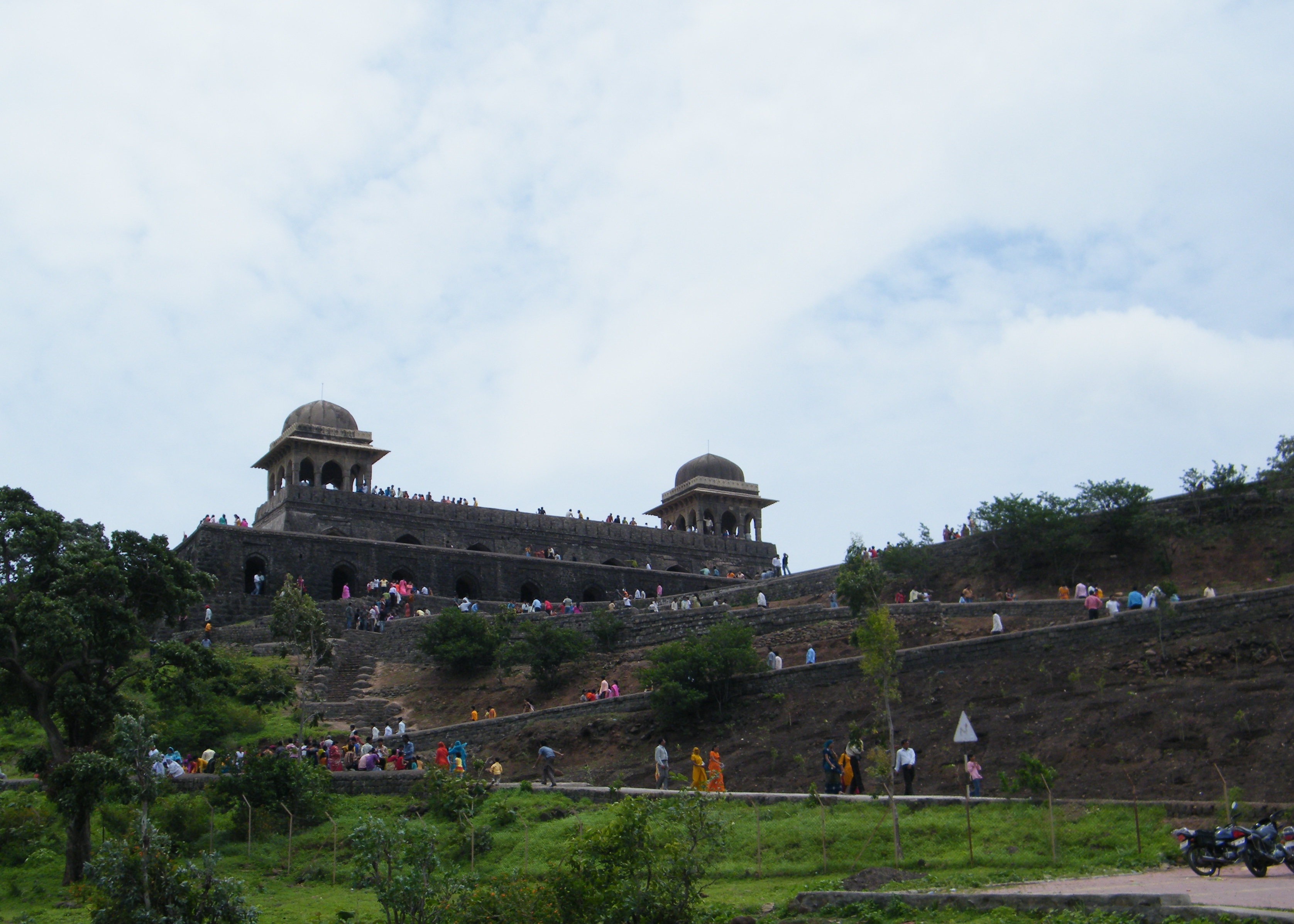
Rani Roopmati Pavilion
The Watchtower Above the Narmada
Overview
Rani Roopmati's Pavilion is a sandstone hilltop pavilion at the southern edge of the Mandu plateau in Madhya Pradesh, standing on the highest point of the fort-city with a sheer drop to the Narmada valley below. Originally built as an army observation post, it is tied to the 16th-century legend of Roopmati, a singer beloved of Baz Bahadur, the last independent sultan of Malwa, who is said to have gazed from here to glimpse the sacred Narmada far below. On clear mornings the river shows as a silver thread. MyTripMyTravel visits it at sunrise or sunset for the light over the valley.
Rani Roopmati's Pavilion crowns the very edge of the Mandu plateau, where the tableland ends in a cliff and the Nimar plains fall away toward the Narmada. It was raised first as a military watchpost, a place to see an army coming from a great distance, and that command of the horizon is still its defining quality.
The romance came later. Legend binds it to Roopmati, a Hindu singer devoted to the Narmada, and to Baz Bahadur, the last independent sultan of Malwa; she is said to have lived here so she could see the sacred river before she ate. From the domed rooftop terrace, on a clear day, the Narmada glints far below like a thread of silver.
MyTripMyTravel times the pavilion for sunrise or sunset, when the light rakes across the plateau and the valley, and pairs it with Baz Bahadur's Palace just below.
At a glance
Rani Roopmati Pavilion in brief
What to see
Highlights
The rooftop pavilions
Twin domed kiosks on the terrace that frame the sweep of the Narmada valley.
The valley panorama
A cliff-edge view over the Nimar plains to the distant Narmada, the reason it was built.
The watchpost architecture
The robust sandstone hall reveals its first purpose as a military observation point.
Baz Bahadur's Palace below
The connected 16th-century palace on the slope, part of the same legend.
Visitor information
Our tips
Come at sunrise or sunset, the valley view and the light are the entire point.
On a clear day, look for the Narmada as a distant silver thread on the plains below.
Pair it with Baz Bahadur's Palace just downhill to complete the legend.
Good to know
Rani Roopmati Pavilion, your questions
Who was Rani Roopmati?
By legend, a Hindu singer devoted to the Narmada and beloved of Baz Bahadur, the last independent sultan of Malwa; the pavilion is tied to their 16th-century story.
What was the pavilion originally for?
It was built as an army observation post on the highest point of the Mandu plateau, commanding a long view over the approaches and the Narmada valley.
Can you actually see the Narmada from here?
On a clear day, yes, the river appears far below as a thin silver line across the plains; haze can obscure it.
How long should I spend there?
About 30 to 45 minutes, ideally timed for sunrise or sunset light over the valley.
More in Mandu
Visit with us
See Rani Roopmati Pavilion, properly.
A private, chauffeured visit with a licensed expert guide, timed for the best light and the smallest crowds. We fold Rani Roopmati Pavilion into a wider Mandu and Central India itinerary, built entirely around you.
- Skip the queue where possible, at the right hour
- Licensed local guide who brings the story to life
- Private car and chauffeur, door to door
Plan your trip
Plan a visit to Rani Roopmati Pavilion
Free, no obligation quote. Your details stay private.