
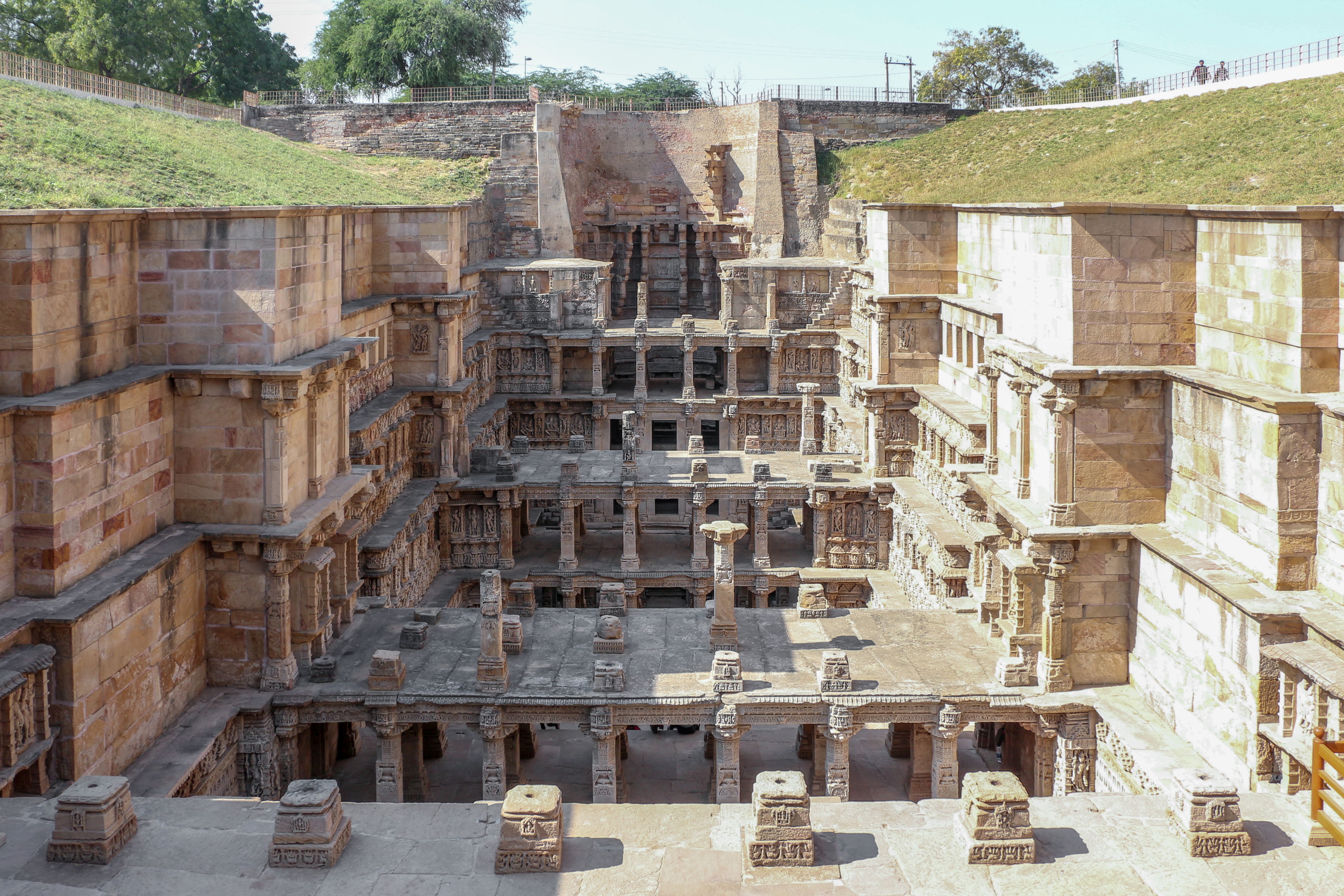
Rani ki Vav
The Queen's Stepwell on the Hundred-Rupee Note
Overview
Rani ki Vav ('the Queen's Stepwell') is an 11th-century subterranean stepwell in Patan, Gujarat, India, built around 1063 by Queen Udayamati in memory of her husband, the Chaulukya king Bhima I. A UNESCO World Heritage Site since 2014, it is an inverted temple over seven storeys, carved with more than 500 principal sculptures, many depicting Vishnu's ten avatars, and over a thousand minor ones. Silted over for centuries by the Saraswati river and excavated by the ASI, it now features on India's 100-rupee banknote. MyTripMyTravel arranges an escorted early-morning visit with an expert guide.
Rani ki Vav is not a well you look into but a temple you descend into, a seven-storey inverted shrine cut down into the earth, where every wall, pillar, and step is dense with sculpture. It is the finest surviving stepwell in India, and one of the most complete pieces of Maru-Gurjara carving anywhere.
Commissioned by Queen Udayamati for her late husband Bhima I, it was engineered as much for devotion as for water: descending panels of Vishnu's avatars, apsaras, and nagakanyas lead the eye down toward a deep draw-well and a reclining Sheshashayi Vishnu. Buried by the Saraswati's silt for generations, it survived almost untouched, which is why the detail is so astonishingly crisp.
MyTripMyTravel runs Patan as an escorted heritage half-day, timed for the soft early light that rakes across the carved tiers, with an expert guide to read the iconography level by level.
At a glance
Rani ki Vav in brief
What to see
Highlights
The Dashavatara panels
Tiered carvings of Vishnu's ten avatars descending the well walls, the sculptural spine of the site.
Sheshashayi Vishnu
The reclining Vishnu on the serpent Shesha near the deepest level, the devotional heart of the stepwell.
The seven storeys
The stepped corridor dropping through carved galleries toward the circular draw-well.
Apsaras & nagakanyas
Celestial maidens and serpent-women worked in extraordinary detail across the pillared tiers.
The banknote view
The framed elevation reproduced on India's 100-rupee note, best in morning light.
Visitor information
Our tips
Go early, the descending sun angle picks out the carving and the deep levels stay cool.
Use an expert guide; the Vishnu-avatar programme is invisible without one.
Pair it with the Patan patola-weaving workshops for a full Patan half-day.
Good to know
Rani ki Vav, your questions
Why is Rani ki Vav on the 100-rupee note?
As a UNESCO World Heritage Site and India's finest stepwell, it was chosen for the 100-rupee banknote, its carved elevation is reproduced there.
What makes it different from an ordinary well?
It is an 'inverted temple', a seven-storey descent lined with over 500 principal sculptures, built for devotion as much as for water.
How long does a visit take?
About 1 to 1.5 hours with a guide to read the sculpture levels and the deep draw-well.
Is it open every day?
Yes, daily from around sunrise to sunset. We time the visit for the best morning light.
Visit with us
See Rani ki Vav, properly.
A private, chauffeured visit with a licensed expert guide, timed for the best light and the smallest crowds. We fold Rani ki Vav into a wider Patan and West India itinerary, built entirely around you.
- Skip the queue where possible, at the right hour
- Licensed local guide who brings the story to life
- Private car and chauffeur, door to door
Plan your trip
Plan a visit to Rani ki Vav
Free, no obligation quote. Your details stay private.