
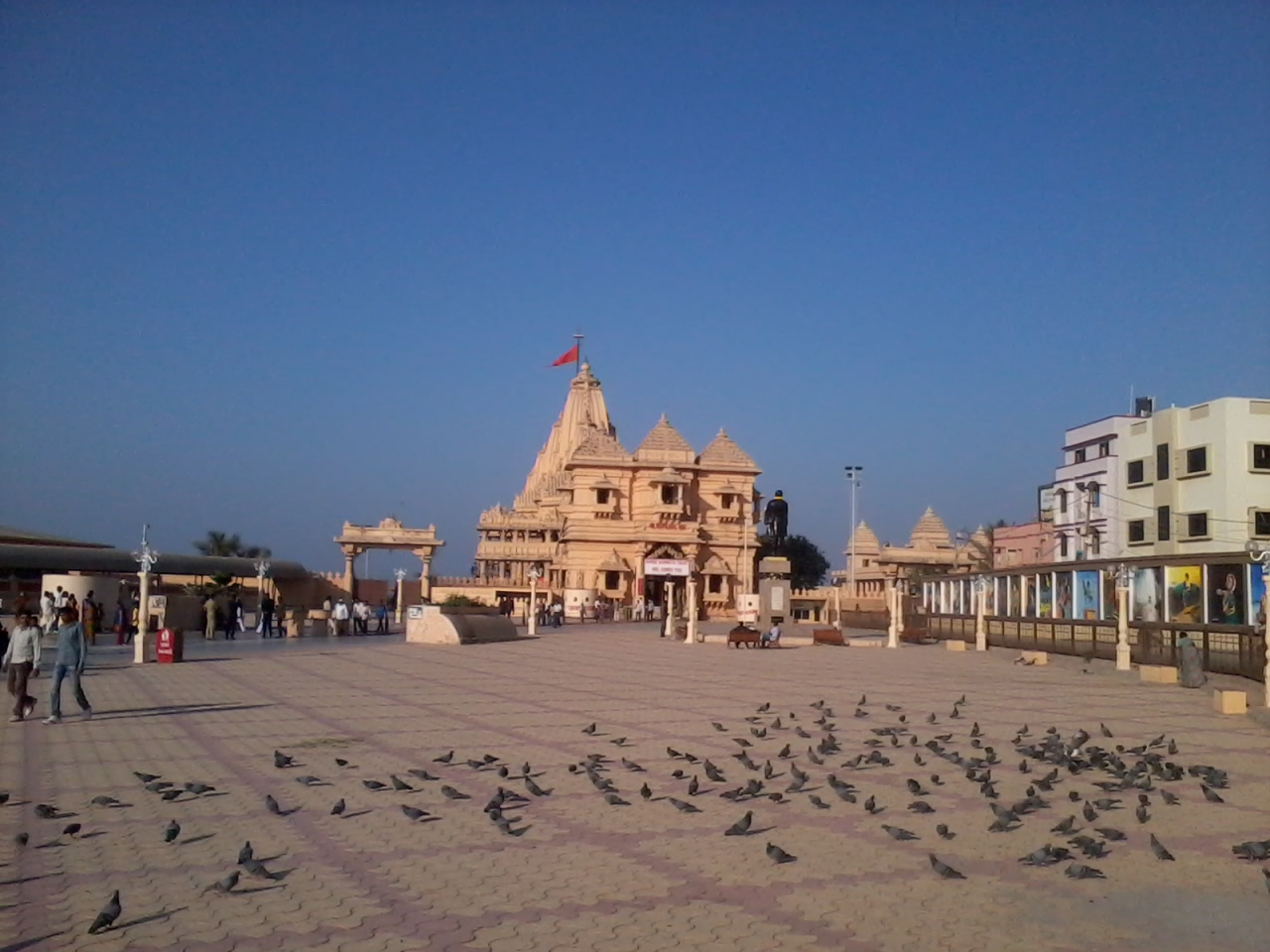
Somnath
The First of the Twelve Jyotirlingas
Overview
Somnath is a coastal temple town on the Arabian Sea in the Saurashtra region of Gujarat, revered as the site of the first among the twelve Jyotirlingas of Shiva. The present Somnath temple, in the Chalukya Māru-Gurjara style, was rebuilt in 1951 after Independence, a project driven by Sardar Vallabhbhai Patel, on a shrine that history records as destroyed and raised again many times, most famously plundered by Mahmud of Ghazni in 1026. Nearby lie Bhalka Tirth, linked to Krishna's departure, and the Triveni Sangam river-and-sea confluence. MyTripMyTravel runs Somnath as a serene coastal pilgrimage, escorted darshan, the evening sound-and-light show, and sattvic Gujarati dining.
Somnath stands where the Saurashtra coast meets the Arabian Sea, and it carries one of the deepest resonances in Hindu tradition, the first of the twelve Jyotirlingas, the self-manifest shrines of Shiva. The temple's story is also one of destruction and resilience: chronicles record it razed and rebuilt repeatedly across a thousand years, most infamously sacked by Mahmud of Ghazni in 1026, and the present structure is a twentieth-century restoration.
That temple, the Kailash Mahameru Prasad, was completed in 1951 in the ornate Chalukya style, its shikhara rising directly above the shore. A pillar in the temple grounds, the Baan Stambh, bears an inscription claiming an unobstructed sea line from this point to Antarctica. A short distance away, Bhalka Tirth marks the spot associated with Krishna being struck by a hunter's arrow, and the Triveni Sangam is the sacred confluence of the Hiran, Kapila, and mythical Saraswati rivers as they meet the sea.
MyTripMyTravel treats Somnath as a place for calm, respectful rhythm. We arrange escorted darshan timed away from peak crush, brief guests on the temple's photography and security rules, include the atmospheric evening sound-and-light show, and pair it naturally with Dwarka up the coast on a chauffeured Saurashtra pilgrimage.
At a glance
Somnath in brief
When to visit
November to February
The coastal winter from November to February is the most comfortable time, with mild days and a steady sea breeze ideal for temple visits and the evening aarti. Maha Shivratri, usually in February or March, is the temple's greatest festival, spiritually powerful but intensely crowded, and best undertaken with careful advance planning. March to June is hot and humid on this exposed coast, while the monsoon (July to September) brings rain and rough seas. The sound-and-light show runs most clear evenings after nightfall.
Things to do
Experiences in Somnath
Somnath Temple darshan
The shore-side Jyotirlinga shrine and its evening aarti, with escorted, respectfully timed access.
Sound-and-light show
The nightly projection-and-narration spectacle on the temple's history, staged in the seafront grounds.
Bhalka Tirth
The pilgrimage spot associated with Krishna's departure from the mortal world, a short drive from the temple.
Triveni Sangam
The sacred confluence where three rivers meet the Arabian Sea, a place of ritual bathing and cremation ghats.
Baan Stambh
The arrow-pillar in the temple grounds inscribed with a claim of clear sea to the South Pole.
Prabhas Patan Museum
A small collection of carved fragments and sculptures salvaged from earlier incarnations of the temple.
Getting there
How to reach Somnath
Diu (DIU), about 85 km, and Keshod (IXK), about 55 km, are the nearest airports; Rajkot and Ahmedabad offer wider connections with a longer drive.
Somnath (Veraval) station is on the Saurashtra network with trains from Ahmedabad, Rajkot, and beyond; we handle station transfers.
The coastal highway links Somnath with Dwarka, Junagadh, and Gir, all of which make natural chauffeured additions.
Our air-conditioned, GPS-tracked vehicles run the Saurashtra pilgrimage circuit, Somnath, Dwarka, Junagadh, and Gir, comfortably.
Where to stay
The best-appointed coastal hotels near the temple, with rooms overlooking the Arabian Sea for early-morning darshan.
Reliable contemporary hotels a short transfer from the temple, offering full comfort and dining.
Quieter, well-run guesthouse-style stays for a calm base with concierge support.
Where to eat
The pure-vegetarian temple-town thali of dal, kadhi, shaak, and rotli, served without onion or garlic near the shrine.
The robust Saurashtra cuisine of bajra rotla, ringan no olo, and sev tameta from the surrounding region.
Gujarat's beloved crisp snacks, ideal for a light bite after morning darshan.
Good to know
Somnath, your questions
Why is Somnath so important?
It is revered as the first of the twelve Jyotirlingas, the most sacred shrines of Shiva. The temple has been destroyed and rebuilt many times across history, and the present structure dates to a celebrated 1951 restoration led by Sardar Vallabhbhai Patel.
Are cameras and phones allowed inside the temple?
No. For security reasons, phones, cameras, and bags are not permitted inside the Somnath temple and must be deposited at cloakrooms before entry. Our escort manages this so darshan stays smooth and unhurried.
Can I get non-vegetarian food and alcohol here?
Gujarat is a dry state, so alcohol is restricted and needs a permit, which we can help foreign visitors arrange. The temple town itself is strongly vegetarian, and its sattvic Gujarati cuisine is excellent.
Can Somnath be combined with Dwarka?
Yes. Dwarka, one of the Char Dham, lies about 230 km up the Saurashtra coast and pairs naturally with Somnath on a single chauffeured pilgrimage route, often with Junagadh and Gir added in.
When is the best time to visit?
November to February, for the mild coastal winter. Maha Shivratri (February or March) is spectacular but extremely crowded and needs advance planning.
How long should I spend in Somnath?
One night is enough to cover the temple, the evening sound-and-light show, Bhalka Tirth, and Triveni Sangam before continuing along the coast.
Continue exploring
Pairs well with Somnath


Plan with us
Design a private journey through Somnath.
Tell us your dates and what you love. Our travel desk builds a private, chauffeured itinerary around Somnath and the wider West India, with handpicked hotels and a transparent quote, usually within a few hours.
Related journeys
Plan your trip
Plan your Somnath trip
Free, no obligation quote. Your details stay private.