
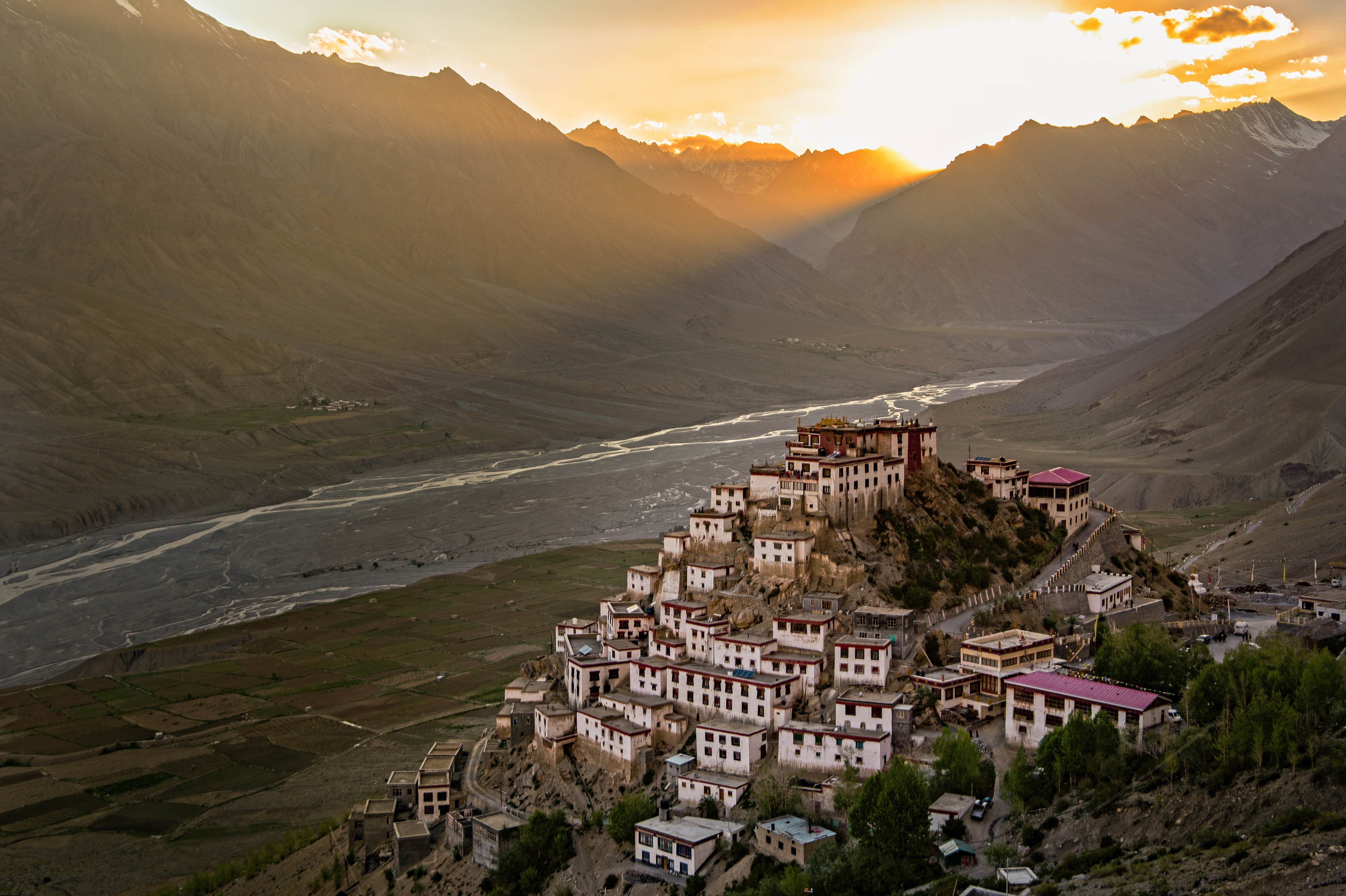
Key Monastery
The Fort-Monastery Above the Spiti River
Overview
Key (Kye/Ki) Monastery is the largest monastery in the Spiti valley of Himachal Pradesh, stacked like a fort on a hilltop at about 4,166 m above the Spiti River, some 12 km north of Kaza. Traditionally traced to the 11th century and the teacher Dromtön, it belongs to the Gelug school and has grown over centuries of rebuilding into a maze of prayer rooms, murals, and thangkas layered up the ridge. It is a working training centre for lamas and one of the Himalaya's iconic silhouettes. MyTripMyTravel visits it on an acclimatised Spiti circuit, altitude and road conditions permitting.
Key Monastery is the postcard image of Spiti, a jumble of whitewashed buildings piled up a conical hill until they resolve into a single fort-like mass against the bare mountains, with the Spiti River winding below.
Its origins are traditionally traced to the 11th century and the teacher Dromtön, a disciple of Atisha, though what stands today is the product of many centuries of destruction and rebuilding, which is exactly why it looks like a fortress: prayer rooms, murals, and thangkas stacked in defensive layers up the ridge. It is the largest gompa in the valley and a living training centre, home to some 250 monks of the Gelug order.
MyTripMyTravel places Key on a properly acclimatised Spiti circuit, never a first-day stop at 4,166 m, with an early visit for the light and, for those who want it, a night in the monastery's simple rooms for the dawn prayers.
At a glance
Key Monastery in brief
What to see
Highlights
The fort-like silhouette
The tiered mass of buildings on its conical hill, one of the Himalaya's most photographed monasteries.
Ancient murals & manuscripts
Wall paintings, thangkas, and books in the layered prayer rooms built up over centuries.
The assembly hall
The main Dukhang, with ritual instruments and arms used in the monastery's festival dances.
The Spiti panorama
Views over the river and the high Kibber plateau from the monastery terraces.
The monastic school
A working training centre for the Gelug order, home to around 250 monks.
Visitor information
Our tips
Spiti sits above 4,000 m, acclimatise over several days and ascend gradually; Key is not a first-day stop.
Access is seasonal; the high roads into Spiti open only in the warmer months, so plan around them.
Simple guest rooms exist at the monastery for those who want to stay for the dawn prayers.
It is an active monastery, dress warmly and modestly and follow shrine etiquette.
Good to know
Key Monastery, your questions
Where is Key Monastery?
On a hilltop above the Spiti River, about 12 km north of Kaza in Himachal Pradesh, at roughly 4,166 m.
How old is it?
Its founding is traditionally traced to the 11th century and the teacher Dromtön; the present tangle of buildings grew up over many centuries of rebuilding.
Why does it look like a fort?
Repeated destruction and rebuilding on an exposed frontier ridge produced its stacked, defensive form, classic dzong-like Himalayan monastic architecture.
When can I visit?
Mainly June to September, when the high mountain roads into Spiti are open; proper acclimatisation to the altitude is essential.
More in Spiti Valley
Visit with us
See Key Monastery, properly.
A private, chauffeured visit with a licensed expert guide, timed for the best light and the smallest crowds. We fold Key Monastery into a wider Spiti Valley and Himalayan Peaks itinerary, built entirely around you.
- Skip the queue where possible, at the right hour
- Licensed local guide who brings the story to life
- Private car and chauffeur, door to door
Plan your trip
Plan a visit to Key Monastery
Free, no obligation quote. Your details stay private.