

Agra
The Eternal City of the Taj
Overview
Agra is a city in Uttar Pradesh, India, on the banks of the Yamuna river, and the home of the Taj Mahal, the marble mausoleum commissioned by Mughal emperor Shah Jahan in 1632. Agra holds three UNESCO World Heritage Sites: the Taj Mahal, Agra Fort, and nearby Fatehpur Sikri. It sits roughly 230 km south of Delhi and 240 km east of Jaipur, forming the eastern vertex of India's Golden Triangle. The optimal visit is a chauffeured one- or two-night stay timed for a sunrise entry to the Taj, when the marble shifts through rose, gold, and white. MyTripMyTravel operates Agra as a precision mission: skip-the-line monument access, an orthopedic-grade fleet for the Delhi to Agra to Jaipur arc, and heritage dining inside restored havelis.
Agra is not a stop. It is the reason the Golden Triangle exists. Every itinerary that matters in northern India bends toward this single bank of the Yamuna, where the Taj Mahal has stood for nearly four centuries as the most photographed building on earth, and still, in person, exceeds the photograph.
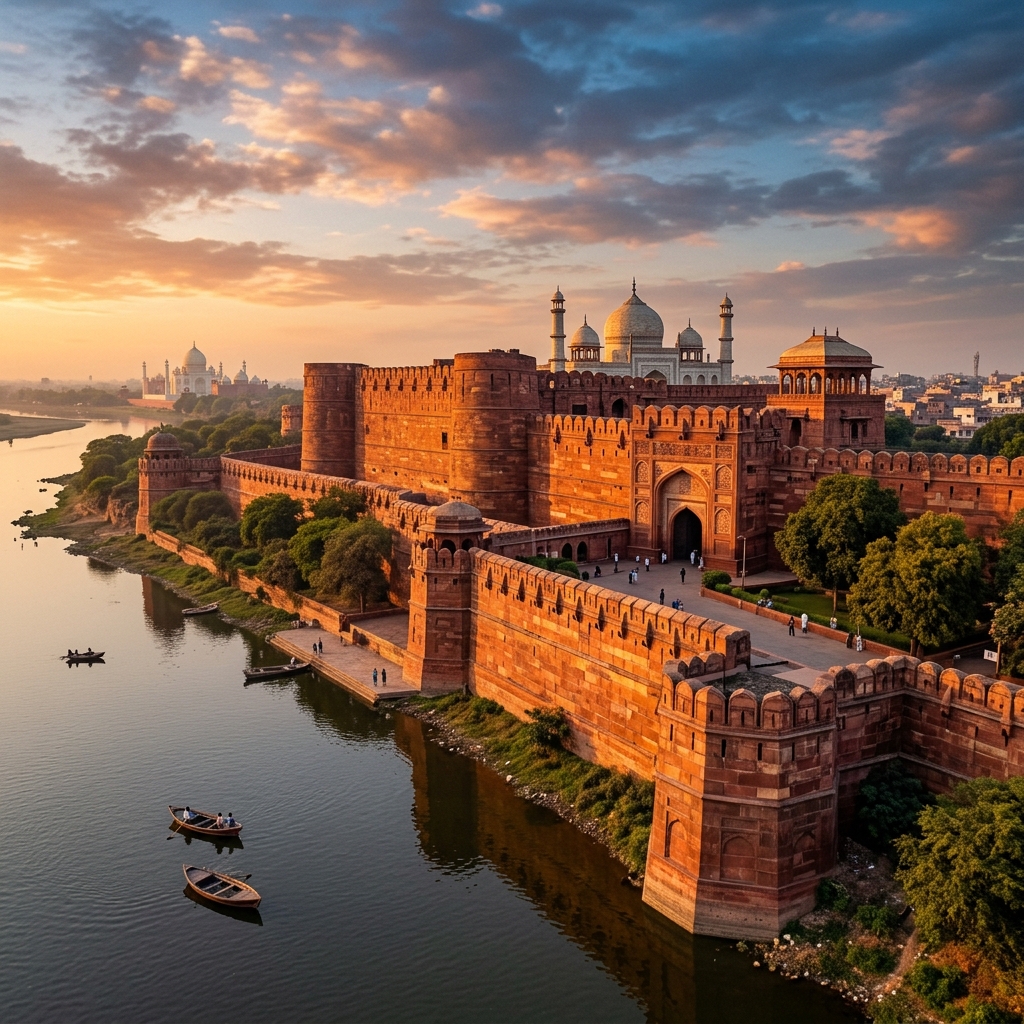
The city was the Mughal capital under Akbar, Jahangir, and Shah Jahan, and that century of imperial ambition left it with a density of monumental architecture matched almost nowhere else. Agra Fort, a red-sandstone citadel large enough to be its own walled city, faces the Taj across a river bend. Forty kilometres west, the abandoned perfection of Fatehpur Sikri preserves an entire Mughal court frozen at the moment it was vacated.
Most visitors mishandle Agra. They arrive late, queue in the midday glare, and leave underwhelmed. The architecture of the visit determines the experience. MyTripMyTravel runs Agra as a controlled operation: pre-dawn departure, escorted entry before the gates open to the general crowd, and a chauffeured exit that turns the onward leg to Jaipur, via Fatehpur Sikri, into part of the journey rather than a transfer to be endured.
At a glance
Agra in brief
When to visit
October to March
The clear winter window from October to March delivers soft light, comfortable daytime temperatures, and the cleanest air for photography. November to February is peak, book Taj sunrise slots well ahead. April to June is severe heat above 40°C and is only advisable with an air-conditioned fleet and dawn-only sightseeing. The monsoon (July to September) brings dramatic skies and emerald gardens but variable visibility; it is the quietest and most private time to see the Taj.
Things to do
Experiences in Agra
Taj Mahal at sunrise
Enter at the eastern gate before opening for the marble's rose-to-white transition without the crowd.
Agra Fort
The red-sandstone Mughal citadel where Shah Jahan was imprisoned with a view of the Taj he built.
Fatehpur Sikri
Akbar's perfectly preserved ghost capital, 40 km west, ideal as a stop en route to Jaipur.
Mehtab Bagh
The moonlight garden across the river, framing the Taj's rear elevation at sunset.
Itimad-ud-Daulah
The 'Baby Taj', the inlay-marble tomb that prototyped the Taj Mahal's craft.
Heritage haveli dining
A private Mughlai tasting menu inside a restored courtyard mansion, arranged through our dining wing.
Getting there
How to reach Agra
The Yamuna Expressway connects Delhi to Agra in about 3.5 hours, the standard MyTripMyTravel chauffeured leg.
The Gatimaan Express reaches Agra Cantt from Delhi in roughly 100 minutes; we handle station transfers either side.
Agra Airport (AGR) has limited service; most missions route through Delhi (DEL) with a fleet handover.
Our orthopedic-grade Innova Crysta and luxury sedans run the full Delhi to Agra to Jaipur arc with GPS telemetry.
Where to stay
Taj-view luxury resorts on the eastern bank with rooms framing the mausoleum at dawn.
Restored colonial and Mughal-era properties in the Cantonment with garden courtyards.
Quiet, low-noise medical-sanctuary stays for post-procedure transit guests with concierge care.
Where to eat
Slow-cooked dum and tandoor courses in a private haveli setting, arranged by our heritage-dining wing.
An escorted tasting of Agra's signature ash-gourd sweet and the old-city street kitchens.
Contemporary Indian tasting menus with Taj-facing terraces for the final evening.
Ready to book
Itineraries featuring Agra
Private, chauffeured, day-by-day journeys that feature Agra or explore the wider Golden Triangle, each fully customisable, or built around your dates.

3-Day Express Triangle
4-Day Classic Circle

5-Day Heritage Loop

5-Day Luxury Weekend

Royal Wedding Scout

GT + Pushkar Culture
Good to know
Agra, your questions
Is one day enough for Agra?
One full day covers the Taj Mahal and Agra Fort if you start at sunrise. To include Fatehpur Sikri and Mehtab Bagh without compression, a single overnight is strongly recommended, which is how our Golden Triangle missions are architected.
Is the Taj Mahal closed on any day?
Yes. The Taj Mahal is closed every Friday for prayers. Our planners build itineraries around this automatically so a Friday is never wasted on a closed monument.
Can you arrange skip-the-line entry?
We pre-purchase timed tickets and provide an escort who manages the security and queue process, so guests enter close to opening with minimal waiting.
How far is Agra from Delhi by car?
About 230 km, or roughly 3.5 hours on the Yamuna Expressway in our chauffeured fleet, including a comfort stop.
Continue exploring
Pairs well with Agra


Plan with us
Design a private journey through Agra.
Tell us your dates and what you love. Our travel desk builds a private, chauffeured itinerary around Agra and the wider Golden Triangle, with handpicked hotels and a transparent quote, usually within a few hours.
Plan your trip
Plan your Agra trip
Free, no obligation quote. Your details stay private.