
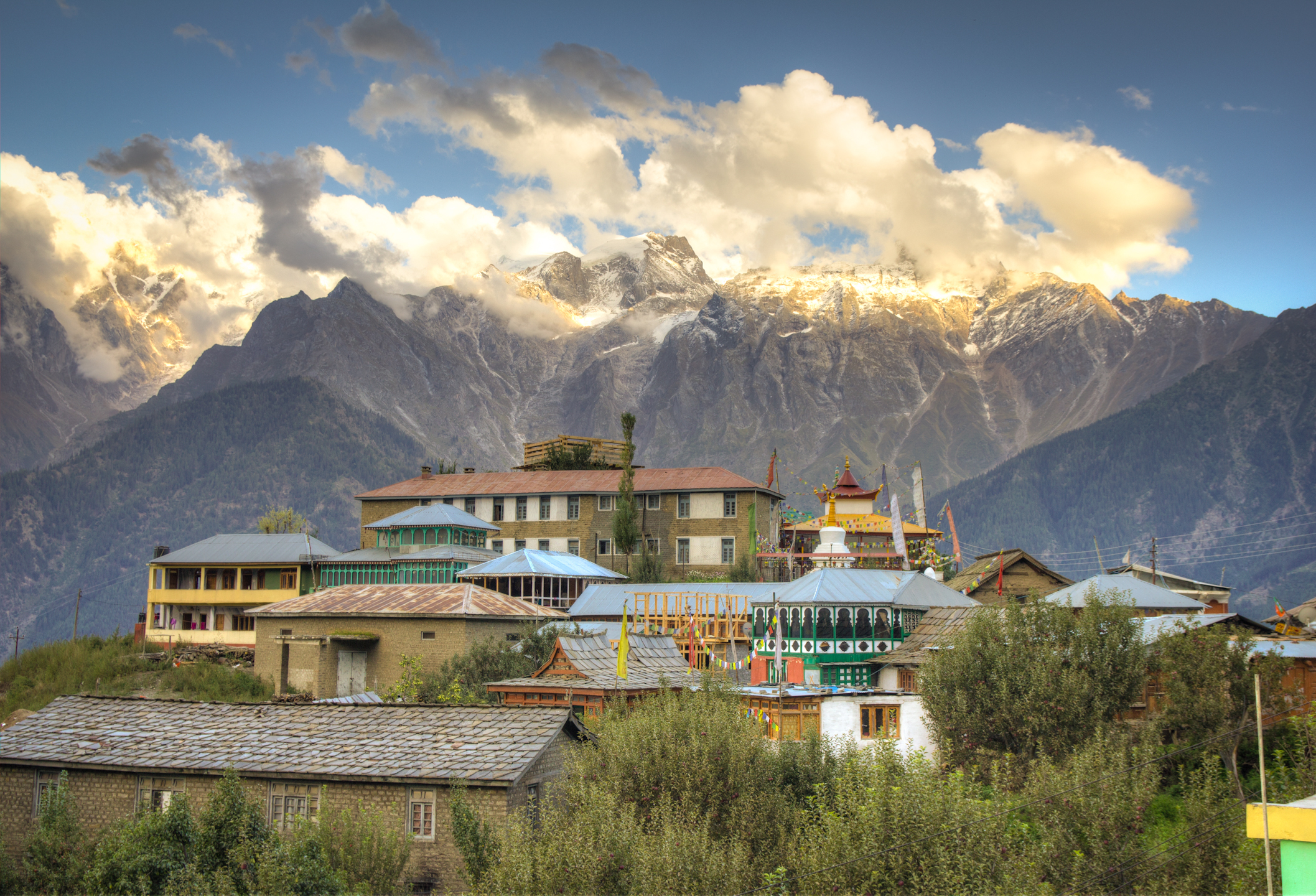
Kalpa
The Balcony Facing Kinner Kailash
Overview
Kalpa is a high village in the Kinnaur district of Himachal Pradesh, India, set at roughly 2,960 m on a shelf above the Sutlej valley on the old Hindustan-Tibet Road. It faces the Kinner Kailash range across the gorge, a wall of peaks rising above 6,000 m that turns gold at first light and is sacred to both Hindus and Buddhists. Once called Chini, it was a favoured retreat of the British, and its slopes carry apple orchards and chilgoza pine. The district headquarters, Reckong Peo, sits just below. MyTripMyTravel runs Kalpa as a slow, high-altitude leg, a chauffeured mountain drive, an acclimatised stay with a Kinner Kailash view, and escorted village walks.
Kalpa is a village that exists to look at a mountain. It sits on a wooded shelf high above the Sutlej in Kinnaur, and across the deep valley stands the Kinner Kailash massif, a run of granite peaks above 6,000 m that Hindus associate with Shiva and that catches the very first and very last light of the day. Guests come here chiefly to watch that light move across the range from a terrace.
The village keeps a layered character. Its old temple, the Narayan-Nagini, and the small Hu-Bu-Lan-Kar Buddhist monastery reflect a frontier where Hindu and Tibetan Buddhist traditions have long overlapped. Apple orchards and chilgoza pine cover the slopes, the district town of Reckong Peo lies a short drive below, and the whole place still moves at the pace of orchard and pasture rather than of a resort town.
MyTripMyTravel treats Kalpa as an altitude posting, not a quick photo stop. The approach along the Sutlej, the old Hindustan-Tibet Road, now National Highway 5, is spectacular but slow and prone to rockfall, so we build in a gentler ascent, an acclimatised night lower down where useful, and unhurried mornings on the terrace. The reward is one of the Himalaya's great mountain views with none of the crowding of the better-known hill stations.
At a glance
Kalpa in brief
When to visit
April to June, September to October
Late spring and early autumn are the surest windows, with clear skies, blossoming or fruiting orchards, and reliable Kinner Kailash views. September and October, after the monsoon, give the crispest air and finest light on the peaks. Winter (December to February) is beautiful but bitterly cold, with snow that can close stretches of NH5 for hours or days. The monsoon (July to August) brings a real risk of landslides and rockfall on the Sutlej road, so we avoid tight schedules then and keep the fleet flexible.
Things to do
Experiences in Kalpa
Kinner Kailash sunrise from the terrace
The essential Kalpa ritual, watching first light climb the 6,000 m range from an orchard-side vantage, coffee in hand.
Narayan-Nagini and Hu-Bu-Lan-Kar
The village's old Hindu temple and small Buddhist monastery, reflecting Kinnaur's blended frontier faith, seen on an escorted walk.
Roghi village and the Suicide Point road
A short drive to the neighbouring hamlet of Roghi past a dramatic cliff viewpoint over the Sutlej gorge.
Apple and chilgoza orchard walk
A guided amble through the terraced orchards that clothe the slopes, apples in autumn, chilgoza pine year-round.
Reckong Peo and the valley market
The district town just below, with mountain views of its own and a working Kinnauri bazaar for shawls and caps.
Getting there
How to reach Kalpa
Kalpa is reached along NH5, the old Hindustan-Tibet Road, up the Sutlej valley from Shimla (≈ 240 km, a long full-day chauffeured climb); the final stretch above Reckong Peo is steep and best driven slowly.
The nearest airport is Shimla (SLV), with limited service; most guests fly to Chandigarh (IXC) and continue by our fleet, breaking the drive overnight en route.
Our GPS-tracked, orthopedic-grade mountain vehicles handle the multi-day Sutlej-valley legs, with drivers experienced on high, landslide-prone Kinnaur roads.
Where to stay
Kinner Kailash-facing hotels and lodges in and just above Kalpa, chosen for the terrace outlook rather than scale.
Family-run Kinnauri homestays among the apple orchards, offering local food and genuine village contact.
More serviced hotels in the district town just below, useful as a lower, warmer acclimatisation base.
Where to eat
Simple, hearty highland food, rajma with local red rice, seasonal greens, and buckwheat rotis, best eaten in an orchard homestay.
Kalpa's celebrated apples in autumn, chilgoza pine nuts, and orchard fruit, tasted straight from the source.
Honest Himachali and North Indian dhaba fare in the district town; dining choices are limited, which our planners set expectations around.
Go deeper
More on Kalpa
Good to know
Kalpa, your questions
Is Kalpa hard to reach?
It is remote but straightforward with the right vehicle. The road is the old Hindustan-Tibet highway (NH5) up the Sutlej, spectacular but slow and, in places, prone to rockfall. We drive it over a comfortable schedule with an experienced mountain chauffeur rather than rushing.
Do I need a permit for Kalpa?
No. Kalpa and Reckong Peo are open to all visitors without an Inner Line Permit. Permits only become relevant deeper toward the Tibet border, beyond the areas most guests visit; we advise if any onward leg requires one.
Will I see the Kinner Kailash peaks?
In the clear-weather windows of spring and autumn, almost certainly, the range fills the view across the valley and is finest at sunrise and sunset. Cloud can hide it in monsoon, which is one reason we avoid that season.
How many nights should I plan in Kalpa?
Two nights is ideal, it allows for gentle acclimatisation to nearly 3,000 m, one full day of village walks and short drives, and two chances at the sunrise view without any rush.


Plan with us
Design a private journey through Kalpa.
Tell us your dates and what you love. Our travel desk builds a private, chauffeured itinerary around Kalpa and the wider North India, with handpicked hotels and a transparent quote, usually within a few hours.
Related journeys
Plan your trip
Plan your Kalpa trip
Free, no obligation quote. Your details stay private.